Showing posts with label Dog Diet. Show all posts

Monday, October 21, 2019

HALLOWEEN SPECIAL - Healthy and Nutritious Pumpkin Treat Recipes for DOGS

by Pilar Bueno

The Way to Your Dog’s Healthy Heart 
is Through Its Stomach

We think of our beloved dogs as friends, sidekicks, guardians and often the most important relationship we have. They give, give and give and we try to keep them happy and healthy.

As dog owners all our lives and now working as professional dog sitters for dozens of dogs of all shapes and sizes, we’ve come to the obvious conclusion that, like with human foods, we’ve all been fed a lie about the pet food industry. The more we’ve researched its practices and oversights the more outraged we’ve become. 

Most processed dog food is full of chemicals, preservatives, E numbers, fillers and meat by-products and God knows what else. And let's not even talk about pet treats, such as "rawhide" one of the most popular and dangerous chews sticks ever! 

The regulations for pet foods is alarmingly very poor and in some cases none existent. Have you ever met a dog food taster? Or read a survey of dogs discussing the food industry? Is it any wonder our babies are becoming sick? They have no voice and the industry is getting away with suffering and murder.......for profit.

In an effort to try to help and advise all dog owners and to ease the dietary suffering of so many beloved pets, we are working on the new book "Dog's Dinner", soon to be published under our sister company VIDDA Publishing 

It is time for us to take control of our own pet's health and nutrition. With so much information available on the internet, and some guidance from us, you will find that it is easier now than ever to make informed decisions and to prepare safe and nutritious dog treats and meals at home. 

So why not start now? If you are wondering what to do with all that Halloween pumpkin, why don't you knock together a few healthy treats for your dog? Pumpkin is full of minerals and vitamins as well as being very low in calories. You can read about the benefits of Pumpkins for your dog in one of our previous blog posts. 

Below are a couple of recipes to get you started. If you prepare these recipes in bulk, you can save cash and have peace of mind knowing that your best friend is healthy, happy and well-fed.

Happy Halloween!

Pilar and John 


If you've found our blog to be useful please don't forget to go to the top of the article and on the right-hand side of the page, you have an option to....


Wednesday, October 16, 2019

Fido's raw meat pet food may be loaded with harmful bacteria: study

October 16, 2019 by Marlowe Hood


Three-quarters of raw meat pet food samples purchased and tested in Switzerland exceeded recommended limits of bacteria known to cause gastrointestinal infections

Increasingly popular raw meat meals for dogs and cats may be full of multi-drug resistant bacteria, posing a serious risk to animals and humans, scientists reported Wednesday.


Three-quarters of samples purchased and tested in Switzerland exceeded recommended limits of bacteria known to cause gastrointestinal infections, and more than half had bugs impervious to drugs designed to kill them, they reported in Royal Society Open Science.

"It is really worrying that we found EBSL-producing bacteria in over 60 per cent of samples," said first author Magdalena Nuesch-Inderbinen, a researcher at the University of Zurich, referring to an enzyme that renders some antibiotics ineffective.

"They include several types of E. coli which can cause infections in humans and animals."


Sales of raw pet food—sometimes called "biologically appropriate raw food", or BARF—have soared in recent years, especially for dogs. Paleo-like diets are said to boost canine vitality and immunity, even if there is scant research to back up such claims.

Indeed, veterinary medical associations in the United States and Canada have raised concerns about raw meat pet food, with reports showing it to be a source of Salmonella and infectious yersiniosis in dogs.

And that, Nuesch-Inderbinen told AFP, is a problem for humans.


"Raw meat-based diets may be contaminated with bacteria that are resistant to multiple antibiotics, including those categorised by the World Health Organization (WHO) as critically important for human medicine," she wrote by email.

Pet lover beware
"There is growing evidence that these pathogens pose a risk of infectious disease to humans not only during handling of feed but also through the contamination of household surfaces and through close contact to the dogs and their faeces."

There are an estimated 140 million dogs and cats in the European Union, and at least as many in North America.


More generally, antibiotic resistance has become a major health crisis across the globe.

More generally, antibiotic resistance has become a major health crisis across the globe.
"The situation with multi-drug resistant bacteria has spiralled out of control in recent years," said co-author Roger Stephan, a professor at the University of Zurich's Institue for Food Safety and Hygiene.

The indiscriminate and sometimes inappropriate use of antibiotics has allowed surviving bugs to mutate into superbugs that outpace the development of new medicines.

Because of the overuse of antibiotics in livestock production, animals raised for consumption have become a major reservoir for antimicrobial resistance.

"Like conventional pet food, most raw meat-based diets are based on the by-products of animals slaughtered for human consumption," the study notes.

To find out exactly how contaminated raw pet foods really are, the researchers tested 51 samples from different suppliers in Switzerland, purchased in stores and on the Internet.

"We advise all dog and cat owners who want to feed their pets a 'BARF' diet to handle the food carefully and maintain strict hygiene standards," said Nuesch-Inderbinen.

"Pet owners should be aware of the risk that their pet may be carrying multi-drug resistant bacteria and can spread them."


More information: Raw meat-based diets for companion animals: a potential source of transmission of pathogenic and antimicrobial-resistant Enterobacteriaceae,
Royal Society Open Science, rsos.royalsocietypublishing.or … 0.1098/rsos.191170

Journal information: Royal Society Open Science

© 2019 AFP

Monday, October 14, 2019

Pet Heath - Prevention is Better than Cure : Household cleaners can damage pets!

If your pets are developing skin allergies or breathing problems it might be something to do with the chemicals you are using in and around your home. I could write a whole book about this subject as most of the same problems obviously can be also linked to human conditions. The difference is we humans can express ourselves and more importantly CHOOSE what chemicals are in our environment, our pets have to rely on our choices and understanding of this cause and effect. If it can affect our health then undoubtedly it will affect your pet's health.

Anyway, here's a very informative video from the amazing Planet Paws to get some foundational info that will hopefully save your family and your pets from suffering and medical expenses.
Any question please feel free to contact us.


If you're planning a long holiday, or just a weekend away from home but you hate the idea of leaving your pets in costly and stressful kennels, we can help and your dogs will love it.

Drop us an email or call us for a chat.

Please feel free to share this post with your friends, it would be much appreciated
Thanks, John & Pilar


Wednesday, October 3, 2018

Beneficial Herbs & Spices for your Dog


I'm a big believer in preventative medicine via diet. This not only applies to myself and my family but it also applies to the animals in my life, especially the many dogs we look after. Correct and balanced nutrition is like making a regular deposit into a high-interest saving account in preparation for possible harder times in the future, a kind of safety net and deposits can be made with every meal we or our dogs consume.

Of course if the 'harder times' don't manifest, you have the good fortune of your acquired 'health' equity to enjoy into your old age. Who doesn't want healthy, pain-free twilight years? The same applies to your dog.

The early signs of inflammation in the body should never be ignored. When the system is showing signs of inflammation it's a signal to you that things are starting to go wrong. The common signs to look for are stomach and bowel conditions, aches and joint pains, skin and hair/fur conditions, rapid eye deterioration. These are all early warning signs that your body is becoming inflamed and sick and if ignored can lead to serious and often life-threatening disease. 

Many things in our lives can cause inflammation but most roads lead to poor, low nutrition diets that are often loaded with toxins such as colourants, sweeteners, bad oils, salts and much worse and scary nasties that I won't go into here but you can find out more by searching through the articles on my other blog.

The easiest way I find to assist my immune system, apart from my vegan diet, is the daily use of a wide range of spices and herbs. It's so simple and effective to apply to your daily routine, you have to wonder why our vets an doctors don't advise us all to do the same!

Our dogs can hugely benefit from the following herbs and spices as well as feeding them a 50/50 diet of meat & kibble /fruit & veg.
Here are my favourite SEVEN ingredients to use for your pooch.


Parsley
Used fresh or dried and used in moderation will help with all inflammation and help fight and prevent arthritis, treat and prevent stomach and bowel issues and is a powerful herb in fighting urinary infections. Your dog will also have a noticeably fresher breath

Ginger
Humans have known about and used Ginger for medicinal purposes for over 2000 years.  As with the use for humans, this powerful root spice is fantastic for treating your dog's upset stomach, relieve nausea,  especially motion sickness. If you are planning to take your dog in the car for any length of journey and you are worried about car sickness, give your dog a flat 1/4 tsp of dried ginger mixed in his food an hour before leaving on your journey. As a bonus Ginger has powerful anti-cancer properties which is why it is a daily part of my own diet.

Basil
This common herb is loaded with antioxidants, antiviral, antimicrobial and antifungal properties which is great news for both us and our dogs. Basil has a very high concentration of beta-caryophyllene which actually belongs to the cannabinoid family and is in many other herbs, such as rosemary, hops, cloves and of course cannabis. It is also found in high concentrations in black pepper.

Basil is an amazing anti-inflammatory and is especially useful in treating arthritis and inflammatory bowel disease.

One lesser known quality is for the treatment for anxiety which can be very common in pet dogs. If this is the case, add some dried basil to the food mix or make some special treats for your dogs. I'll add a simple, generic biscuits recipe and the end of the article. This is a great way to add these ingredients into treats so that your dogs have a regular supply.

 Milk Thistle
This is another favourite herb used for 1000's of years by our ancestors. It has incredible anti-inflammatory and antioxidant properties for humans but is often referred to as the 'Miracle Herb' for dogs. It's a must if your dog is suffering from digestive problems, although if this is the case, it's worth covering the research into the actual ingredients of the food you're feeding your pets.

It's easily available from most health shops, either in capsules form or as a liquid. Either way, it's easy to add to the dogs' food mix. Just add 1/4 teaspoon per 20lb of your dog's body weight. If your dog is overloaded with possible toxins, Milk Thistle will help remove them via the liver. This is recommended advise throughout the veterinary professions. But please if you are worried that your dog has consumed something toxic, don't hesitate, call your vet immediately. 

The miracle ingredient is a flavonoid called Silymarin. At the moment the pharmaceutical industry is increasingly confident that this substance helps in the treatment of serious liver conditions such as chronic hepatitis and cirrhosis.

Who'd have thought that the weed at the end of most gardens could have such beneficial properties?

Mint
Dog Breathe!! Everyone knows what I'm talking about. Just like us, it's easy for your dog to consume a treat with a little mint and it'll not only help his halitosis it'll also aid digestion.

It's a real easy herb to grow in pots and is a great addition to any kitchen.
Wild Mint, Spearmint and peppermint are all non-toxic to dogs but according to The Prevention of Cruelty to Animals, the English species Penyroyal (Mentha pulegium) should be avoided.

I'm saving my last two favourite ingredients until last.

Spirulina
Spirulina powder is blue-green algae and its scientific family name is "cyanobacteria". It is universally recognised as a superfood packed with a wide range of beneficial nutrients.

A single tablespoon (7 grams) of dried spirulina powder contains:
Protein: 4 grams.
Vitamin B1 (Thiamin): 11% of the RDA.
Vitamin B2 (Riboflavin): 15% of the RDA.
Vitamin B3 (Niacin): 4% of the RDA.
Copper: 21% of the RDA.
Iron: 11% of the RDA.


It also contains decent amounts of magnesium, potassium and manganese, and small amounts of almost every other nutrient that we need and it has the same benefits for your dogs' health. It also has up to 60-70% of its dried weight made up of protein. 


Thanks to its powerful nutrients, spirulina can fight inflammation, ease digestive issues, reduce arthritis symptoms, improve mental function, enhance natural detoxification, and fight cancer (that’s just to name a few benefits).

It should be administered by mixing into meals or home-made snacks, 1/4 teaspoon per 2-lbs of dog.

IMPORTANT:
Blooms of blue-green algae in standing water, usually during the summer months can produce harmful toxins which stop a dog’s liver from functioning properly. However, not all types of blue-green algae are dangerous.

Sadly, exposure to toxic blue-green algae is often fatal, and can also cause long-term health problems in dogs that survive after drinking or swimming in algae-contaminated water. Some types of blue-green algae can kill a dog just 15 minutes to an hour after drinking contaminated water.

Dogs who have been swimming in water can get the algae caught in their fur, and can ingest it while cleaning themselves later on.

Concentrations of the algae vary throughout the year and may not always be harmful - but you can’t tell simply by looking at them whether or not they are dangerous, so it is best not to run the risk of allowing your dog to come into contact with water where the algae may be present.

The powdered and dehydrated forms in the correct amounts are beneficial as discussed above.


Now to my favourite spice of all.

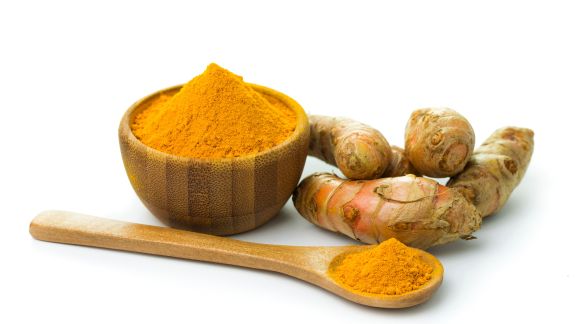
Turmeric
Turmeric is a yellow spice that’s often used to flavour Indian cuisine. Along with its blast of flavour, the powerful spice has been used for its medicinal purposes for centuries. Turmeric’s therapeutic benefits are believed to be a result of its bioactive ingredient curcumin (not to be confused with cumin).
It was widely used in traditional Chinese medicine as well as Ayurvedic medicine. Today, pet nutritionists recommend you give it to your pooch! Similar to how it benefits humans, adding turmeric to your pet’s diet can help ward off cancer, fight inflammation, aid digestion, kill dangerous parasites, and boost mood.

When it comes to turmeric, a little goes a long way! For every 10 pounds, add just a 1/4 of a teaspoon.


Here is one of our favourite home-made biscuit treat recipes. Any of the above herbs and spices can be added to this recipe, your dogs will love them.

Doggie Fruity Digestive
Ingredients
  • 240 grams of spelt or rice flour 
  • 1 large egg 
  • 1 tablespoon of olive oil 
  • 120ml hot water 
  • 1 low sodium stock cube 
  • Add any other safe ingredient: blueberries, pumpkin seeds, sunflower seeds, diced apple or banana 

Instructions

Mixed together the egg and the oil and gradually add the flour and all other chosen ingredients until a firm consistency is created. On a floured surface roll out the dough to approx ½ inch thickness. Either make into balls and flatten with palm of your hand to make rough cookies or used a shaped cookie cutter.

Place on baking tray with ½ inch spacing and bake at 180C for 15-20 minutes. Take out and cool and store in a paper bag to keep crunchy.

For easy treats try raw fruit and vegetables such as carrot pieces or celery pieces dipped in unsalted peanut butter (with no artificial sweetners, especially Xylitol), banana chunks, frozen or fresh blackberries. Your dog might be cautious at first basically because he doesn’t recognise these new foods. I found a sure way to get your dogs to try new varieties of fruit and veg is to sit on the floor with them and share the treat, one for me one for the dog, works every time.

Finally, remember if you’re cooking yourself any vegetables always prepare a little extra for your dog. My dog always has Sunday dinner with us; he just loves a large bowl of steamed sweet potatoes, a few brussels sprouts, some cabbage or kale and a few carrot and peas. To finish off, I put on a good ladle of gravy made from the vegetable water. Our dog licks his bowl clean every time.

Please feel free to contact us at the number and email on our banner at the top of the page.

We have 10% off all Dog/House Sitting bookings running to the end of the year, including all booking made for 2019.
Thanks
John Hodges

IMPORTANT: Like humans all dogs are different. Occasionally what works for one animal can be detrimental to another animal. Like humans, some dogs develop allergies to foods, including spices. If you notice any signs of allergic reaction contact your nearest vet immediately.


Tuesday, October 2, 2018

10% OFF - DOGS AT HOME - HOUSE SITTING

10% Off ALL BOOKINGS BEFORE CHRISTMAS & 2019

If you're planning a long holiday, or just a weekend away from home but you hate the idea of leaving your pets in costly and stressful kennels, we can help and your dogs will love it.

Drop us an email or call us for a chat.

Please feel free to share this post with your friends, it would be much appreciated
Thanks, John & Pilar


Sunday, August 26, 2018

Dogs At Home - House Sitting

#InternationalDogDay

As many of you are aware Pilar and I, while in the UK over the last five years, have had the pleasure of looking after many clients houses and pampered pooches while they relax on vacation or fulfil business engagements. The length of the house sits have ranged from a single day to five full weeks; all are repeating clients.

We take our work very seriously. The health and happiness of the dogs we look after is our priority. We tailor exercise and diet accordingly to the wide range age and breeds we work with. We feel very honoured to have a very large and extended dog family up and down the country with wonderful clients.

When our clients have to leave the family home for whatever reason, they need to feel secure that the family dog is receiving the best of care. Diet, exercise and affection (that's the easy part for us) are essential to minimise the stress for the animal while being separated from their human family. The idea of putting the family dog into kennels is not an option for our clients, I'm very pleased to say. For most dogs, this is a very hostile, foreign and scary environment. They have no idea where the owners have disappeared to or even if they are returning. Dogs are emotional animals and a day or a fortnight in doggy prison, no matter how luxurious, can change a dog's personality forever. 

Happy dogs need to be in their own environment with all the familiar smells, toys, places to sleep, walking routes, diet and no competition from strange dogs. A familiar routine and family environment equals wagging tails. 

As well as loving care for the dogs, we will guarantee the best security for your home. Apart from the obvious dog walking and food shopping, we will spend the majority of our time in your home. The property will show no signs of being empty for extended periods of time and your cars will be safe on your drive.

Our new business, 'Dogs At Home - House Sitting' is being launched this month. Not only are we taking requests and bookings for standard dog/house sitting, we are also offering on the job nutritional plans for ailing and sick dogs of which we have vast amounts of experience. We are also offering a photographic portfolio and updates uploaded online here at the Dogs At Home blog 

For the first time, we are also offering our services outside of the UK. This is a service we have declined in the past because of other obligations. But now after too many requests, we are offering our services ANYWHERE around the globe. Our fees will remain the same as for our UK clients but travel expenses and other travel expenses will be charged.

Additionally, in the coming weeks and months, we will be looking for the 'right' people to come and join the team. All potential applicants will be required to go through the DBS police security check. We will then conduct in-house or online interviews.

If you have free time, are prepared to travel with your own transport, have a clean record, love dogs and have experience with canine care, this could be the perfect job for you, couples are preferred. 

Our services come fully insured and we can provide references from our established and happy clients, many at the top of their professions.

For more details or booking requests or just a chat please either give us a call (UK 07976 268332) or email us at DOGS AT HOME
John and Pilar


Thursday, August 23, 2018

Dogs are OMNIVORES - Wild berries for dogs


It's just a fact, modern dogs are omnivores and need a wide spectrum of plant based foods in their diet to maintain health and vitality. It will also mitigate you from the cost of vet bills, plus the worry and pain that many of us go through at the end of life with our beloved pets. Prevention is better than cure. Shhh, don't tell your pet insurance company this. 

Evolutionary biologists in the study of how genetic code of the domestic dog differs from that of the wolf, have discovered starch assimilating genes that suggest that canine evolution in part was sparked by wolves adapting their diets to eat more like us. (See my previous blog entry) or check this BBC coverage by Jonathan Amos - Science correspondent.

Below is a short clip of one of our client beautiful dogs, Lois picking blackberries for herself. Once I showed how a few years ago she now happily gorges herself when the opportunity presents itself. Our dogs evolved as seasonal foragers, just like us and their biology benefits the same as ours.


Here are some additional superfoods for your dogs that you can introduce. If they're not familiar they may at first turn their noses up at your new food offering, just like children and some adult do. Be patient and I suggest sitting and sharing the food with them. Once they realise it's good and enjoyable for you they'll soon cotton on. Some of these they'll enjoy raw but the greens I suggest a gentle steaming preparation and before feeding make sure they have cooled appropriately.


In the near future, I'll be posting some great recipes so that you can prepare food in bulk and freeze. Also, some really tasty snack for your dogs so that you can give them the best diet with knowledge and care.

Please feel free to comment and share. 
Or contact about Dog Sitting or dietary advice at dogsathomesitting@gmail.com


A special thanks to the Roberts family and their wonderful dogs


Sunday, August 19, 2018

WHY DOES MY DOG EAT GRASS?


I've had dogs throughout my life, from the day of my birth when I was greeted into this world by the family's black Labrador Retriever, Zena, to our current furball called Buster, our freaky little Bichon Frise.

All of our dogs have been rescued from a life of loneliness and abuse and neglect. All of them have been embraced by our family, spoilt rotten, squeezed, played with and loved unconditionally as family members, bringing joy into our home. They've all lived long and happy lives with three of them surviving into their twenties. I can't imagine a life that didn't include mans best friend.


Now in my 50th year, when not travelling the world photographing wildlife, myself and my partner spend our time working all over the country (UK) dog/house sitting. We also advise on diet and nutrition to help reverse common ailments that the pooches we look after are often afflicted with. 


Even though I say so myself we've had great success in reversing some serious conditions in very short periods of time, just by feeding the dog in question a highly nutritious diet and not just one or two food groups like most dogs suffer with for their entire lives. Can you imagine the boredom, the same meals, every day....forever!

I realised at a young age that a dog like humans needs a wide range of vitamins and minerals to maintain a vital and strong immune system for robust health. In fact, you can see a modern correlation between our societies increasing epidemic of preventable illness and the soaring statistics in our pet dogs state of health. Humans and dogs have the similar diet-related diseases such as diabetes, heart disease, depression, arthritis, cancers, high blood pressure, skin and gum problems and the list go on. The majority of GP's and nutritionists will advise people with ill help to increase the inclusion of fruit and veg into the diet. It's not rocket science, is it?

Humans and dogs (both complex mammals) have a mind-blowingly intricate biological construct and immune system all built from the foods we all eat. 

Like humans, dogs are biologically omnivores. In the wild canines forage seasonal fruits, dig up tubers and consume other plants when meat or carrion is not available, which is most of the time. This is a massive evolutionary survival advantage which helped dogs integrate with mankind so successfully. The hungry wolves that came close to humans as they sat around campfires in the cold of the night, thrived on the scraps they were given. In return the canines became part of an extended pack/tribe, defending, hunting, bonding, relieving stress and even keeping the early human tribes warm at night. 

If the wolves were a pure hunter, killer carnivores, mankind would have been treated as just another prey animal and today we would not be spending millions a year on toys, specialist foods, beds, etc, etc. Most wouldn't admit it but many people I know and have worked with would choose their dog over almost anyone else, even family. You know what I'm talking about.

But the question I get asked the most is 'why does my dog eat grass?'

The most common idea that I hear as an explanation is the dog eats grass because it's trying to make itself vomit.

I believe this to be only partly correct, but not for the reason you'd expect.
Studies have shown that only 8% of dogs that eat grass have had previous signs of illness. But 22% of dogs that eat grass do in fact vomit.

The dogs that were ill before eating the grass were the animals most likely to vomit. This 2008 is a study based on 1500 animals and clearly shows that over 75% of the dogs do not vomit after eating grass. 

However, if the dog from an early age eats grass they rarely vomit later in life when it is ingested.

As with all good scientific enquiry, this leads to the fundamental question, Why?

Well, maybe the early wolf/dog/man relationship actually changed the domesticated animal towards a more omnivorous diet from the supplementation of food from humans. The resource of fresh meat would have been a relatively rare and valued commodity in early man. Would the early man have readily shared meat with the scruffy canine sculking in the shadows? Or would he have shared his staple, starchy foods such as fruits, berries, nuts seeds, plants and tubers and even primitive bread? 

The individual dogs that had the evolutionary, mutational advantage of being able to digest these fats and starches would have been selected by man's early tribes. They would have been easier to feed and less aggressive because of decreased competition and therefore selected as easier animals to domesticate. The increased diet of plant based food would have changed the actual brain evolution also, selecting a more social and maybe intelligent animal. 

Our modern dog is starting to wag its tail through the mists of time, often more at home with humans than it's own kind.

Of course, a belly full of starchy food requires an after dinner belly rub. This is an all too familiar scene that echoes back into man and dogs distant history and relationships. Some would say that the dog helped domesticate mankind because of this interlinked relationship....I'll take that. 

I think this is more likely and would have steered the evolution of the digestive system over time to the more domesticated, modern animal into our recognisable, omnivorous dog.

So what about eating grass I hear you asking. I'm getting there, trust me.

I would suggest that another reason for eating grass is to increase intestinal mobility to help control and rid themselves of intestinal parasites. Many other mammal species do this, including primates.

But my personal preference in explaining this practice of dogs eating grass goes as follows. With the processed dog food industry mass producing some very questionable foods (extremely poorly regulated) our pooches often suffer from acidic stomach problems, just like we do. Grass is a highly alkaline food with high fibre and one of the richest in nutrients in the whole plant kingdom, I take wheatgrass juice regularly myself, I highly recommend it.

Our dogs appear to be not only self-medicating but also eating grass for the health benefits and they seem to really enjoy it. Going back to the wolf ancestors, these animals hunt mostly ruminant animals such as all species of deer, goats, cattle etc. 

A ruminant is typically defined as a mammal that has a four-compartment stomach, which includes. The rumen (paunch) The reticulum (“honeycomb”) The omasum (“manyplies”) The abomasum (“true stomach”).


These animals mostly eat grass but do take in other plants which are then mixed with salvia rich in enzymes, fermenting the plant material in the rumen stomach compartment. Ruminants do not chew their food as they graze. They bite and swallow, it's about getting quantity into the system and then when full they 'ruminate' or chew the cud. This process is when the animal regurgitates the plant material and then re-chews it, swallows it and repeats the process, sometimes for hours. The plant material as it breaks down goes through the other digestive compartments, into the intestines, then bowel and eventually exist but not before extracting all of the nutrients.

When a ruminant is killed by canines, the stomach is usually full of fermenting grass and this is consumed and becomes part of the animals' makeup, even giving a nutritional advantage. They even develop a taste for this source of partly digested plant material.

Does our dog eating grass echo their historical hunting and nutritional needs of wolves? I think that is very plausible.

I've also witnessed that some dog like to eat ruminants faeces, especially horse and cow. We used to look after four rescued Dobermans and a couple of horses. The one dog in particular who had been viciously abused and starved used to make a beeline for the stables when I was mucking out the horses, gorging herself on horse manure. Tessy (her name) was still in survival mode even though she had everything she could need from her loving family. These were her survival instincts kicking in, an echo from her ancient ancestors struggling to survive in leaner times.

So next time your dogs want to graze the lawn for you, please remember they might be saying something about their diet to you. They could well have some digestive issues linked to their diet and it's very hard for them to communicate that, obviously.

With all the dogs we look after the diet we provide them is a 50/50 mix of the normal food provided by the owners and 50% fresh and lightly steamed vegetables. Such as broccoli, kale, cabbage, sweet potato, carrots and peas. It's no biggy for us as we are #vegan and so we just prepare extra at meal times.


They love it all and empty their bowls. Sometimes at first, they don't recognise what has been served. I then have to get on the floor with them and eat some myself to build confidence, feeding a little by hand. After all, if it's good enough for the alpha male in the pack (yeah that's me) then it is safe and good enough for them. It doesn't take long to catch on. We also encourage a little natural foraging when in season. You show a dog how to identify and pick berries (they love blackberries) you'll find it hard to stop them, and it's great for them.

My Personal Favourites Plant-based Dog Foods

  1. CARROTS: contain beta-carotene that nourishes the optic nerve and improves eye health. 
  2. BROCCOLI: nutrient-rich and contains anti-carcinogenic properties such as sulforaphane which help strengthen the immune system. 
  3. CELERY: improves heart health and fights cancer. 
  4. GREEN BEANS: improves blood fat ratios and protects against oxidative stress. They also contain heart-healthy omega 3 fatty acids
  5. SPINACH: anti-inflammatory, improved cardiovascular functions’, and helps prevent cancers. 
  6. PUMPKIN: amazing benefits for dogs the suffer from digestive issues, especially useful to treat diarrhoea because of the high fibre content which absorbs water.

In the long term, this is all preventative medicine for your dog. It will save you a fortune in vet bills and most importantly it will avoid the painful suffering that all too many pets go through in silence.

Conclusion: Dogs eating grass is completely normal, even with a nutritionally appropriate diet. However, it is always worth introducing daily plant based foods, especially greens high in chlorophyll because like us humans these nutrients are essential for maintaining a robust immune system and healthy life. Don't forget to mix it up though, they get bored with the same foods just as we do. You could even refrain from cutting a small part of your lawn, just let it grow just for mans best friend.

I hope my long-winded waffling clarified this issue. If you have any questions or are interested in our dog/house sitting services give us a call or drop me an email, the info is below.

Regards


 Click Here
click on the image